In the design of pressure vessels, particularly for nozzle-to-shell junctions, accurate assessment of local stresses under internal pressure and external loads is paramount. These regions are prone to stress concentration and fatigue, making their analysis critical. Engineers routinely use established design bulletins such as WRC 537 or WRC 297 to evaluate the stress intensification effects caused by external piping loads or internal operating pressures on nozzles.
One of the key parameters used in these calculations is the nozzle neck thickness. However, engineers are often split between two choices: should the nominal wall thickness of the pipe be used? Or should the minimum pipe thickness, accounting for manufacturing tolerances, be considered?
While the difference may appear small, typically around 12.5%, this decision has direct consequences on stress results, compliance with the ASME code, and ultimately the safety and reliability of the vessel.
In this article, we will examine this issue from multiple perspectives: theoretical, practical, and code-based, with special reference to ASME BPVC Section VIII, Division 2 (2023 Edition), and the implications for WRC-based stress evaluation.
Stress in pressure vessels is inversely proportional to thickness. For a cylindrical shell or pipe under internal pressure, the hoop stress (σh) is defined as:
σh=(P × R)/t
Where:
P = internal pressure
R = the mean radius of the nozzle neck or shell
t = wall thickness
From this equation, it is evident that a reduction in wall thickness increases stress proportionally. In localized analysis such as nozzle-to-shell intersections, even small variations in thickness can lead to elevated stress concentrations, potentially exceeding allowable limits, especially under combined loading conditions (pressure + piping loads + thermal expansion).
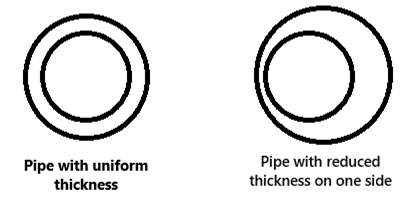
Consider a pipe with the same outer diameter but varying thickness across the cross-section:
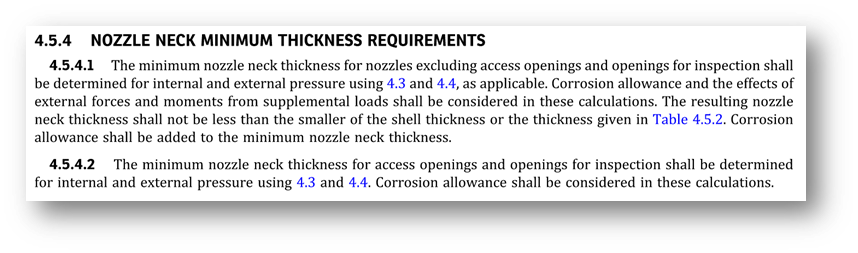
ASME BPVC provides guidance and mandatory requirements regarding thickness usage in both design by rule and design by analysis. Two critical references from the 2023 Edition clarify how thickness must be interpreted for analysis:
This clause directly supports the principle that design must be based on minimum metal thickness. In other words, even though the nominal wall may be 10 mm, the pressure design and analysis should be based on the minimum actual thickness after accounting for undertolerance — typically 12.5% for seamless and welded pipe, unless otherwise stated in the material specification.
This section outlines how the minimum required nozzle neck thickness is to be calculated based on internal/external pressure and supplemented by external loads. Specifically:
• 4.5.4.1: “The resulting nozzle neck thickness shall not be less than the smaller of the shell thickness or the thickness given in Table 4.5.2. Corrosion allowance shall be added to the minimum nozzle neck thickness.”
• 4.5.4.2: Similar provisions apply for access and inspection openings.
The intent is clear: the minimum wall thickness (after considering tolerances and corrosion allowance) forms the basis for compliance. Any analysis, whether elastic stress analysis or WRC-based local assessment, must begin with the most conservative value — the least thickness the component will have in service.
This section outlines how the minimum required nozzle neck thickness is to be calculated based on internal/external pressure and supplemented by external loads. Specifically:
• 4.5.4.1: “The resulting nozzle neck thickness shall not be less than the smaller of the shell thickness or the thickness given in Table 4.5.2. Corrosion allowance shall be added to the minimum nozzle neck thickness.”
• 4.5.4.2: Similar provisions apply for access and inspection openings.
The intent is clear: the minimum wall thickness (after considering tolerances and corrosion allowance) forms the basis for compliance. Any analysis, whether elastic stress analysis or WRC-based local assessment, must begin with the most conservative value — the least thickness the component will have in service.
WRC 537 and WRC 297 are empirical methods derived from finite element results and test data. They are widely used for estimating stresses at nozzle junctions when subjected to loads such as:
• Axial force (tension or compression)
• Bending moment (in-plane and out-of-plane)
• Internal or external pressure
One of the main inputs in WRC methods is the nozzle neck thickness (tn). The calculated stresses (primary and secondary) are directly affected by this value, since they influence the local flexibility and stress indices (SIFs).
If the analysis is performed using the nominal thickness (say 10 mm), the resulting stresses will be artificially lower compared to those calculated with the minimum expected thickness (say 8.75 mm). This could potentially result in underestimation of local stresses and misclassification of stress categories (e.g., primary vs. secondary), and under certain conditions, may lead to unsafe designs.
Let’s consider a standard SA-106 Grade B seamless pipe (NPS 12-inch Sch. XS) used as a nozzle, with a nominal thickness of 12.7 mm and a manufacturing tolerance of −12.5%:
Minimum design thickness = 12.7 mm × 0.875 = 11.1125 mm
In WRC 537 / WRC 297 / FEA analysis:
• If nominal thickness is used, calculated membrane and bending stresses may fall within allowable limits.
• If minimum thickness is used, stresses increase — and might require design changes (e.g., thicker nozzle, pad reinforcement, or nozzle relocation).
Therefore, using minimum thickness from the outset ensures the design remains conservative and code compliant.
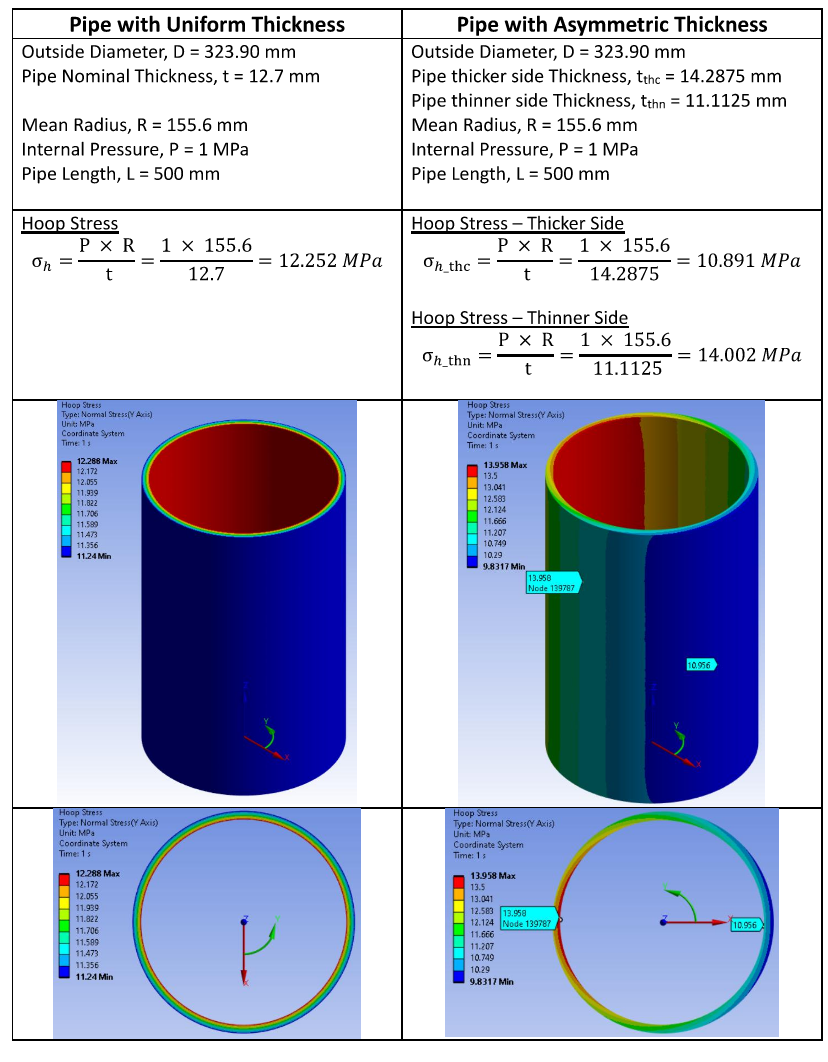
Here we performed simple two FEA analysis:
ASME further requires that corrosion allowance be considered in addition to undertolerance. For example, if a 1.6 mm corrosion allowance is specified, then:
Effective thickness for stress analysis = 12.7 mm × 0.875 – 1.6 mm = 9.5125 mm
This is the thickness to be used in elastic finite element analysis or WRC calculations, not the nominal 12.7 mm. Failure to use this reduced value compromises the credibility and conservatism of the analysis.
• Always refer to ASME VIII-2, para. 3.2.10.2 and 4.5.4 when modeling nozzle or pipe components.
• Deduct manufacturing tolerance (commonly 12.5%) from nominal thickness before performing elastic stress analysis or using WRC bulletins.
• Add corrosion allowance to the required thickness when sizing components.
• For fatigue analysis or cyclic service, this conservative approach is even more critical.
• Document the assumption clearly in the design report (e.g., “Nominal t = 12.7 mm, Mill Tolerance = 12.5%, CA = 1.6 mm, Minimum t used in analysis = 9.5125 mm”).
The practice of using minimum wall thickness in nozzle stress analysis is not just a matter of engineering judgment—it is codified in ASME BPVC Section VIII, Division 2 (2023 Edition). Both paragraph 3.2.10.2 and section 4.5.4 make it clear that manufacturing tolerances must be accounted for in thickness selection for both design and analysis. Using nominal thickness in WRC-based analysis can lead to unconservative stress estimates and code non-compliance.
Designing conservatively, especially at critical junctions like nozzle connections, ensures long-term vessel integrity, regulatory compliance, and operational safety. When in doubt, choose the thinner path—it’s the one ASME paved for safer engineering.
-